


Direct fire continuous rotary kiln (patented) for production of Plaster / Plaster of Paris or Anhydrite II, but not at the same time.
Performance/It Works:
The calcining of the gypsum, is done inside the rotary kiln, HR3 or HR5 according to the required capacity. It is a continuous, and counter current, rotary kiln, and the gases are in contact with the product. It is designed to produce 100% of plaster / plaster of Paris, or 100% of Anhydrite II because of the high temperatures for calcining the product, up to 800ºC.
For the heat generated in the combustion is received for the product for its dehydration, we have a powerful fan that facilites the circulation of heat air through the kiln in the reverse direction to the material: countercurrent.
In this type of kiln, specially designed to produce plaster/plaster of Paris or Anhydrite II, the inlet chute introduces the gypsum inside the chamber formed by the intermediate tube and the inner tube, called the “Preheating Chamber”, where the temperature raises softly. Then, after remaining in that chamber some time, the product is introduced inside the inner tube, called the “ Calcining Chamber”, where is carried out the calcining of the product at the setting temperature. Finally, after remaining the product some minutes in that chamber it is introduced inside another chamber, formed by the outter tube and the intermediate tube, called the “Cooling chamber”, where the material is cooled. As part of the termal energy of the product in the “cooling chamber” is transferred to the product inside the “Preheating chamber” the efficiency is so high. Because of this very special process, the range of temperature of the product at the outlet is from 90ºC to 300ºC.
The temperatures of calcination in this kiln, can reach to 800ºC.
The patented technology of MONTERDE kilns does that can be obtained a Plaster and Anhydrite, of the best quality at the lowest possible cost.
CALCINATION UP TO 800º
The energetic profit thanks to our technology, is so big in our kilns that for high calcination temperatures, the output temperature of the gases filter are between 90 and 110 grades, enough so that condensations do not happen.
Although our kilns are designed for the dehydration and calcination of calcium sulfate “raw plaster”, to obtain Plaster and Anhydrite II; Also it is possible to dehydrate or calcine any other mineral or product, that allows a temperature range from 0 to 800º, and a granulometry of suitable entry for the desired production.
MONTERDE KILN BASIC FEATURES
THERMAL ENERGY CONSUMPTION
New patented low-temperature calcination system. It further reduces consumption (approx. 15%) and increases the stability of the material.
PRODUCTION AND DIMENSIONS
TYPES OF FUEL THAT CAN BE USED
The necessary caloric energy in order to carry out the gypsum dehydration in Monterde kilns can come from diverse sources of fuel energy:
GRANULOMETRY MONTERDE KILNS


Direct fire continuous rotary kiln (patented) for production of Plaster / Plaster of Paris, or for production of Plaster / Plaster of Paris and Anhydrite II at the same time.
How it Works:
The calcining of the gypsum, is done inside the rotary kiln, HR1, HR2 or HR4 according to the required capacity. It is a continuous, and counter current, rotary kiln, and the gases are in contact with the product. It is designed to produce plaster for construction
(Plaster with a percentage of Anhydrite II) or plaster of Paris for prefabricated elements.
The flow through out the kiln of the hot gas that transfers the thermal energy for calcining the product is provided by a fan. The flow of the gas is opposite to the flow of the product (counter current).
In this type of kiln, specially designed to produce plaster and a controlled percentaje of Anhydrite II at the same time, the inlet chute introduces the gypsum inside the chamber formed by the outter tube and the inner tube, called the “Preheating Chamber”, where the temperature raises softly; then, after remaining in this chamber some time, the product is introduced inside the inner tube, called the “ Calcining Chamber”, where is carried out the calcining of the products at the setting temperature.

The calcining temperatures in this kiln, can reach up to 300ºC.
The patented technology of the MONTERDE kilns makes it possible to obtain both, Plaster/Plaster of Paris and Anhydrite II, at the same time, being the quality of the products very high at the minimum cost.

CALCINATION UP TO 300º
Because of the “patented” technology of our kilns, the efficiency of the system is very high, taking into account that the product output temperature is up to 300 degrees C and the range of temperature of the gases in the bag filter is from 90 to 110 degrees C, just for avoiding condensations inside the bag filter.
Although our kilns are specially designed for calcining calcium sulfate dihydrated “gypsum”, to obtain Plaster, Plaster of Paris and Anhydrite II; it is possible to calcine other products, within the range of temperaturas up to 300ºC, if the inlet product granulometry is suitable for the capacity required.
BASIC CHARACTERISTICS OF KILN MONTERDE PLASTER
THERMAL ENERGY CONSUMPTION

New patented low-temperature calcination system. It further reduces consumption (approx. 15%) and increases the stability of the material.
PRODUCTION AND DIMENSIONS

TYPES OF FUEL THAT CAN BE USED
The necessary thermal energy in order to carry out the gypsum dehydration in Monterde kiln can come from diverse sources of fuel energy:
GRANULOMETRY MONTERDE KILNS


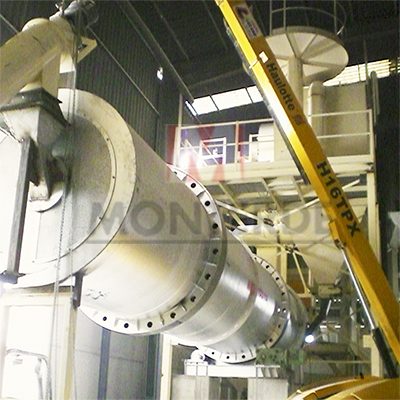

A Cooler is a continuous rotary machine that reduces the temperature of Plaster, Plaster of Paris, or Anhydrite II, from a average inlet temperature of 180ºC upto 80/90ºC at the outlet. At the same time, as is it a direct type cooler, the plaster calcined with a direct fire or indirect fire kiln is re-hydrated.
Being the cooler a machine which works with the exchange of heat between the enviroment air and the product; its efficiency depends on the enviroment temperature, and the outlet Winter temperature is lower than the Summer outlet temperature.
Constructive Elements:
1 Tube made of steel plate.
Inlet chute.
Blades for stirring and advancing the product, dispossed appropriately inside the tube.
2 rings made of steel, monunted on nerves welded to the tube. The nerves have ventilation holes.
4 support rollers for the rings.
Motor and gearbox with machine-cut gears enclosed in air-tight casing in oil-bath.
Being our coolers MONTERDE designed for cooling and re-hydratating the Plaster, the Plaster of Paris, and the Anhydrite II, it is possible to cool many other products if they have the suitable granulometry and inlet temperature.
TECHNICAL CHARACTERISTICS OF DIRECT ROTARY COOLER


* Cooler performance will vary based on material grain size and ambient temperature.
TECHNICAL CHARACTERISTICS OF INDIRECT ROTARY COOLER


* Cooler performance will vary based on material grain size and ambient temperature.